
Prop of a stump

Hi guys!
I may need an help from you!
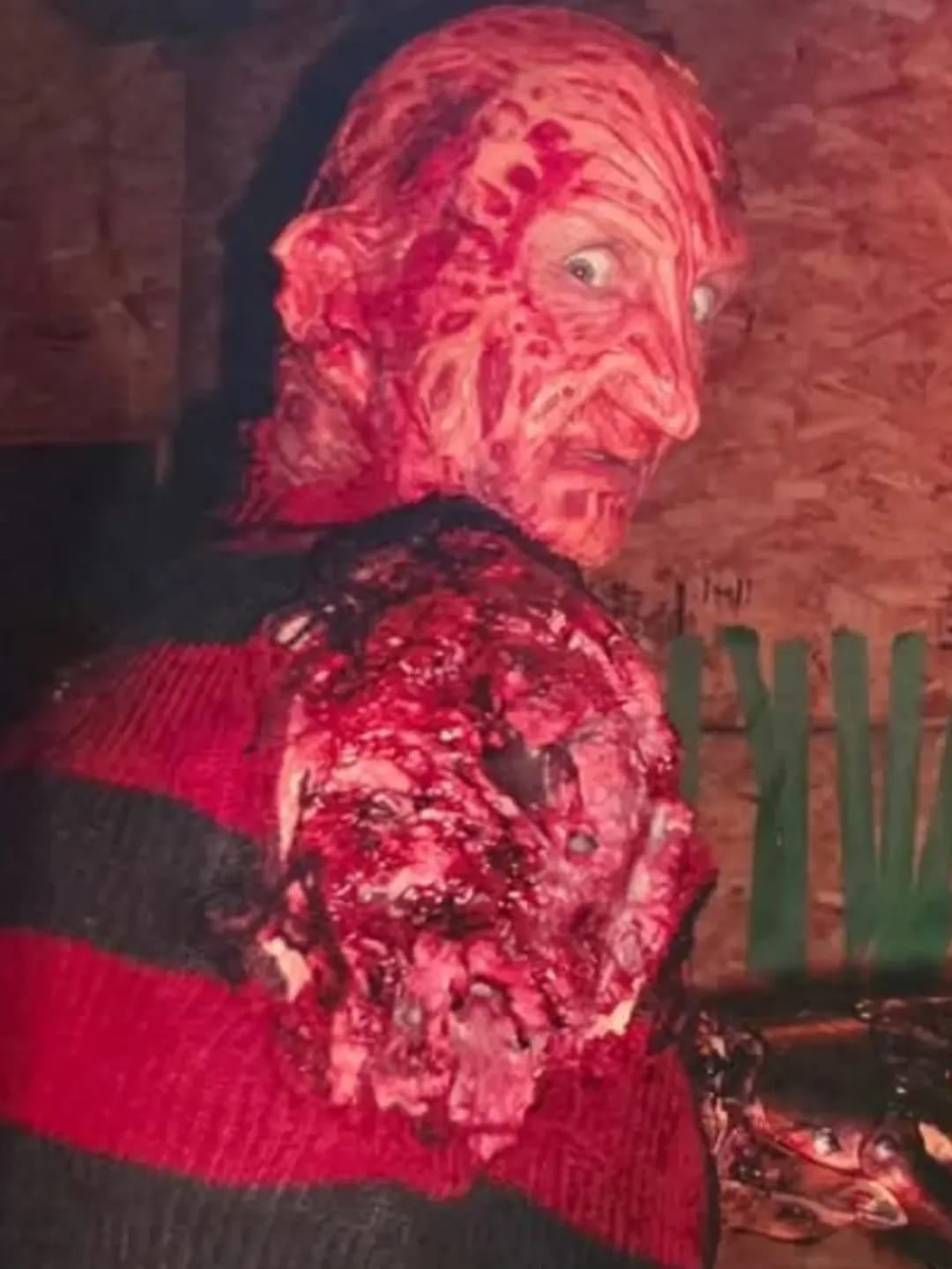
I need to recreate the stump shoulder of Freddy Krueger in Freddy vs Jason, but I've never done anything like that before. I have done body silicone props so the sculpture and the pouring/painting process is ok for me, but never done a silicone prop reusable which can be attached to the shoulder with a string or something.
I'm not sure of how should I make the sculture and the mold. The guy asked me to making it "that can be slipped on like a sock" and i'm thinking what can I use?
Here are the references:

Thank you so much in advance for your help!!!
I may need an help from you!
I need to recreate the stump shoulder of Freddy Krueger in Freddy vs Jason, but I've never done anything like that before. I have done body silicone props so the sculpture and the pouring/painting process is ok for me, but never done a silicone prop reusable which can be attached to the shoulder with a string or something.
I'm not sure of how should I make the sculture and the mold. The guy asked me to making it "that can be slipped on like a sock" and i'm thinking what can I use?
Here are the references:
Thank you so much in advance for your help!!!
0
Comments
The harness would be similar to a corset; either laced or velcro straps would work, and it does 2 jobs. 1: Helps hold the actor's arm behind their back so they don't have to strain their muscles holding that position manually. 2: Gives you an attachment point for the prosthetic stump.
It's important to work with the actor when designing the harness so you can ensure it both fits properly and that it is able to hold their arm in the desired position without applying too much pressure, cutting off blood flow, or causing discomfort. Every performer will have differing levels of flexibility and tolerance for discomfort. It's also important to design both the harness and the wardrobe so that it is easy to release the actor's arm between takes or setups so they can move around freely, eat, drink, use the restroom, etc.
Finally, the wardrobe helps cover the harness and the point where the prosthetic blends into the body.
How you attach the prosthetic to the harness is up to you. It could be straps, snaps, velcro, etc.
/Chris
Or maybe doing a flat prosthetic and then attach it on top of the harness/shoulder brace with straps/snaps (will they grab the silicone as well?? never done this kind of support so i'm not sure of how attach silicone to other materials)
He already has the sweater and I asked him to not cut it, I was thinking to cut and adapt the wardrobe when he has the prostethic on, in that case I can see when and how to cover the harness.
He doesn't have a big budget so i'm trying to think smart and stay as low as I can with costs but making it good to see (that's why I would like to use silicon and silicon paint)
Thank you Chris for your kind help!!
I hope you can share your progress with us here!
/Chris
I will surely share the work in progress with you!!
Thanks a lot for the precious advices
I forgot to share the final results here, but here are some pictures of the fitting test:
In the pictures it seems more red and vibrant than in real life, dunno why.
By the way since he was a scare actor and he needed something to wear by himself I opted for a shoulder medical tutor. I made the base with polyurethane foam and the prosthetic piece is sculpted directly on it with Platsil 10 + Thixopol and attached with magnets (both incapsulated in the polyurethane foam and into the silicone part).
He wanted something that was close to the movie Freddy vs Jason.
What do you think?
Any feedback and tips to improve the next time are welcome
I like the ragged texture and depth you were able to get there.
Since you wanted feedback, here are a few things I might try on the next version:
- Get a little bit of broken arm bone sticking out (very short), cast in soft material for safety.
- Vary the layers of flesh, adding some yellow/white fat layers near the outer surface.
- Add a little bit of torn skin that matches the mask color on the outside surface.
- Apply blood selectively to the skin/bone/fat, so you have variation in color. Leave bits of the skin, muscle, and bone with no blood.
/ChrisFor the bone could I use maybe soft clay? never done a prosthetic bone before!
You could do the bone in silicone as well. A couple of possible ways: clay sculpt, mold, and cast the bone fragment in silicone, or sculpt a negative shape in clay and cast silicone in it, skipping molding. Could also foam-fabricate the bone and then brush a silicone skin onto it. Lots of ways to go about it.
/Chris